
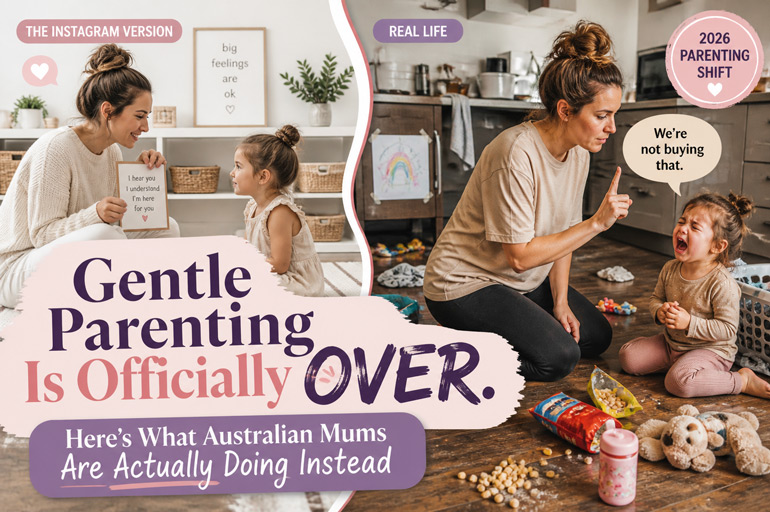
Gen Z parents are quietly dropping gentle parenting – and honestly, who can blame them? Here’s the messier, more honest approach taking over in 2026.
Let’s talk about the parenting trend that promised everything and delivered… a lot of guilt and a child who’s still not dressed at 8:45 am.
Gentle parenting had its moment. A genuine one. It shifted the conversation around big feelings, emotional connection, and the kind of old-school discipline many of us grew up with and swore we’d never repeat. For a while there, it felt like a revelation.
But then reality set in. And reality, it turns out, has a toddler who doesn’t care about your validated feelings script.
Parenting researchers and child development experts are now confirming what exhausted mums have quietly known for a while: the version of gentle parenting that went viral – the perfectly scripted, never-raise-your-voice, negotiate-every-boundary approach – isn’t working for most families.
And in 2026, parents are starting to admit it out loud.
So What Happened to Gentle Parenting?
To be fair, actual gentle parenting – rooted in attachment theory and the work of developmental psychologists – is solid. It’s about connection, consistency, and treating children with respect. Nobody’s arguing with that.
The problem is the version that spread on social media. The one who looked like staying calm during a 40-minute meltdown over the wrong colour cup. The one where setting a boundary required a five-step validation process before you were allowed to actually hold it. The one where saying ‘because I said so’ felt like a parenting fail instead of a perfectly reasonable Tuesday evening response.
That version left a lot of parents feeling like they were doing it wrong. All of it. Constantly.
And they were, only because they were trying to follow a model that wasn’t designed for real life. It was designed for Instagram.
The Numbers Don’t Lie
It’s Gen Z parents – the generation that championed gentle parenting – who are walking it back fastest. And honestly, that tracks.
Multiple surveys tracking parenting styles in 2026 found that Gen Z parents are increasingly describing their approach as hybrid – combining genuine empathy with actual, non-negotiable limits. They still want the emotional connection. But they’ve quietly added something back in that pure, gentle parenting left out: the word no.
As one 2026 parenting trend report put it, the shift is toward ‘boundaries with empathy’ – which sounds simple but is a meaningful pivot from what gentle parenting became in its most extreme form.
And mums? They are relieved.
What Are Aussie Mums Actually Doing in 2026?
Most parents are landing somewhere in the middle of a few different directions. Some are leaning into lighthouse parenting … being that steady, warm, non-panicking presence while letting kids navigate their own storms. Others are firmly in the FAFO parenting camp, letting natural consequences do the teaching so they don’t have to script a response at 6pm when they’re trying to make dinner.
But most Australian mums aren’t following any named approach at all. They’re parenting by feel – pulling from what works for their specific child, on that specific day, with however much sleep they got last night.
In other words: hybrid parenting. And according to the research, it’s actually the most evidence-backed approach going.
Why Rigid Parenting Styles Were Always Bound to Fail
Dr Justin Coulson of Happy Families Australia has pointed out that the healthiest parenting in 2026 looks less like following a rulebook and more like reading the room. A three-year-old having a meltdown at Woolies needs something completely different from a 14-year-old pushing boundaries at 11 pm.
What children need most is a parent who is warm and consistent – not one who nails a specific technique every time. Imperfect parents who show up reliably raise kids who feel secure. Perfect-scripted parents who are quietly burning out? That’s a different story.
What Hybrid Parenting Actually Looks Like
Here’s what’s working for real Australian families right now:
- Empathy first, but briefly. Acknowledge the feeling, then hold the limit. ‘I hear you, you’re upset. And we’re still leaving at 8:30.’ You don’t need to stay in the feeling for 20 minutes to validate it.
- Natural consequences can do their job. Forgot the lunchbox? That’s hungry. Didn’t pack the bag the night before? That’s a rushed morning. These are excellent teachers and they work for free.
- You’re allowed to be the parent. You don’t have to negotiate every limit. Some things are just not up for debate. That’s fine. Actually, it’s good.
- Your own needs count. Gentle parenting at its most intense required parents to be endlessly regulated, patient, and available. Hybrid parenting says: you’re a person too. A tired, trying-their-best person. That counts.
The Part That Actually Matters
None of this means gentle parenting was wrong. The core ideas – connection, empathy, not shaming kids for having big feelings – are genuinely valuable. They moved parenting conversations in a direction that was needed.
But if you spent the last few years feeling like a failure because you couldn’t stay completely calm during the third meltdown before breakfast, here’s your official permission to let that go.
What produces happy, emotionally secure, resilient kids is consistent. They need a parent who’s present, who loves them, who holds limits with warmth, and who shows up – not one performing a perfect script they read online.
You already know more about your child than any parenting trend does. Trust that. And if you occasionally say ‘because I said so and I’m the grown-up’ – you’re in very good company in 2026.
If you’re navigating childhood anxiety alongside all of this: connection and warmth, whatever your parenting label, remain the strongest protective factors researchers keep finding. No style name required.
You’ve got this mama!
You might also like:
- Oops, I Walked In on My Teen! How to Keep Your Cool During Awkward Parenting Moments
- Mum Shares Clever Decluttering Hack For Busy Mums and We’re For It!
- How a Group of Memphis Grandmas Rescued Two Babies Became Everyday Heroes




1 Comment
Don’t you know that when kids start school they are told “kids have rights”
How are we supposed to teach them anything when they are told that they don’t have to do / listen etc to what parents ask them to do if they don’t want to. We can’t physically stop them from doing something they decide to do. They can walk out and go where they wish to and parents have no power / say in the matter. It’s pretty hard to communicate with a child / teenager who doesn’t want to be communicated with.