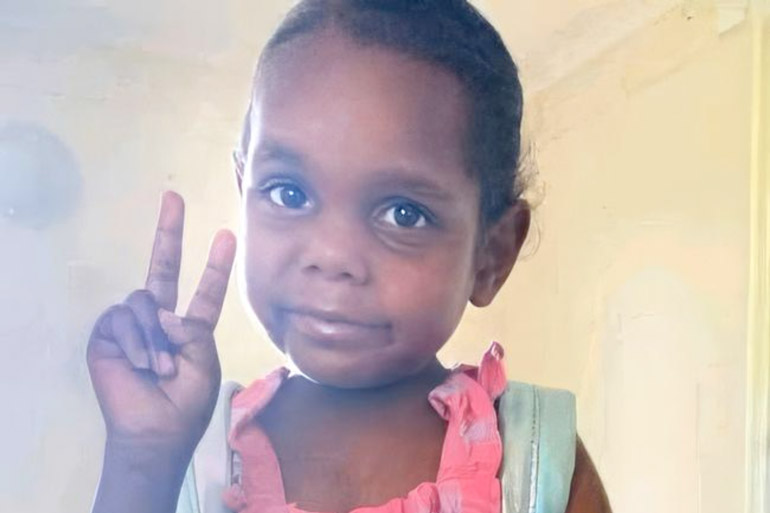
🖤 Cultural Warning: This article contains the name and image of an Aboriginal child who has passed away. Out of respect for Warlpiri and broader Aboriginal cultural practices, we acknowledge that viewing images or names of deceased Indigenous persons may be distressing, particularly for those currently observing Sorry Business. We have followed the family’s guidance in our use of the name Kumanjayi Little Baby and the image approved for media use, and will honour any updated wishes from the family immediately. Our deepest condolences are with her family, community, and all those grieving. 🖤
The Tragic Death of Kumanjayi Little Baby and Why Australia Needs to Get Out of Its Own Way
She was five years old. She communicated with her own hands. She was put to bed by her mother at 11pm on Anzac Day, and she never came home.
This is the story of Kumanjayi Little Baby. And it’s one every Australian needs to read.
Her mother, Jacinta White, released a statement after her daughter’s remains were discovered that stopped us in our tracks.
“I know you are in heaven with the rest of the family. Me and your brother will meet you one day. We are giving our lives to Jesus. It’s going to be so hard to live the rest of our lives without you. Ramsiah wants to tell you that when he sees you in heaven, he is going to give you the biggest hug ever.”
In the wake of her death, Jacinta asked that her daughter’s birth name be set aside, and that she be known as Kumanjayi Little Baby. In Warlpiri culture, Kumanjayi is a substitute name used for a deceased person, to avoid the taboo of speaking their name after death. It’s a profound act of love and cultural protection – a mother trying to give her little girl peace, even now. We honour that completely.
What happened to this precious child is beyond words. But what happened around the search for her – and the man allegedly responsible – raises questions that every single Australian needs to sit with.
She deserved to be safe
Kumanjayi Little Baby and her mother, Jacinta, had visited Old Timers town camp on the outskirts of Alice Springs on Saturday night to do some washing at the home of people they knew well. It wasn’t their home. They were there to do laundry. A social gathering had started up at the house, and Jefferson Lewis, 47, just happened to be there – a man who, according to Assistant Commissioner Malley, had only a “loose connection” to Sharon’s family.
This matters. Jacinta didn’t invite this man into her home. She took her little girl to a neighbour’s house to do the washing, and he was there.
Police were called out to the party that night, but no offences were detected. Lewis was captured on police bodycam footage at the gathering, wearing a distinctive yellow shirt – the same one later seized by forensic investigators at the crime scene.
Police were there. They saw him. And at that point, there was nothing they could legally do.
And then, at around 11pm, Jacinta put her little girl to bed inside the house. By 11.30pm, people at that gathering allegedly watched Jefferson Lewis lead Kumanjayi away from the house, holding her hand. And nobody said anything.
Not at 11.30pm. Not at midnight. Kumanjayi’s mother didn’t report her missing until 1.35am. That’s almost two hours that a non-verbal little girl – a child who communicated with her own hands and had no way to cry out for help – was out there in the dark with him. 1News
We’re not here to pile onto a grieving mother or a community already in pain. But those two hours are part of this story. And they’re part of what needs to be examined honestly if anything is ever going to change.
Reports circulating in the community suggest Lewis had allegedly been turned away from at least one other town camp earlier that evening, before making his way back to Old Timers – meaning there were people who instinctively knew something was wrong with his presence. If confirmed, that detail needs to be front and centre of the formal investigation.
Her body was found just before midday on Thursday, in bushland five kilometres from the camp, after five agonising days of searching.
The police were there, and their hands were tied
Her body was found just before midday on Thursday, in bushland five kilometres from the camp, after five agonising days of searching.
Lewis had been released from prison without conditions, despite a lengthy list of criminal convictions. When officers attended that party and saw him on bodycam, they had no legal grounds to detain him. He hadn’t yet done anything they could formally act on.
This is the system failing in real time. A man with a violent history, six days out of prison, standing in front of police at a late-night gathering, and nothing could be done. Within hours, a child was gone.
The question of mandatory ankle monitoring for repeat violent offenders isn’t a radical one. It’s practical. It’s reasonable. It’s catastrophically overdue. If Jefferson Lewis had been electronically monitored upon release, police would have had a digital trail from the very first moment. As it was, Lewis didn’t have a vehicle, a phone or even a bank card, rendering every modern investigation technique effectively useless. He was a ghost. And a little girl paid for that with her life.
The largest search in Alice Springs history – and who actually found him
What followed was an operation of extraordinary scale. Scores of police, emergency services workers, defence personnel, Aboriginal trackers and community volunteers scoured the area with helicopters, drones, horses, dogs and all-terrain vehicles.
More than 200 people, including local volunteers and business owners, participated across six square kilometres of outback terrain. One of the biggest searches the Northern Territory has ever seen.
And in the end, it wasn’t any of that which found him.
A local resident told the Daily Mail how it unfolded: a group of young men spotted Lewis near Charles Creek Camp, recognised him from the news, and took matters into their own hands.
“They ran up to him and started beating him viciously,” the local said. “He was trying to get under a shipping container; he might have been sleeping there or just trying to get away from the mob.”
Lewis was allegedly beaten badly before police were called.
He was rushed to Alice Springs Hospital under police guard. More than 100 people gathered outside, throwing rocks at the windows, screaming for Lewis to be brought out. Police deployed tear gas and rubber bullets. Reports of a police vehicle set alight. Projectiles thrown at officers.
The rage of that community is not hard to understand at all.
But here’s what we need to hold onto alongside all of that:
The community found him. Not the drones. Not the thermal imaging. Not the helicopters. The people who know this country, who move through it every day, who recognised a face on the news and acted – they found him.
What if they’d been trusted from the beginning?
The Warlpiri people aren’t simply a community in grief. They’re one of the most extraordinary tracking cultures on earth.
Reading the bush. Reading the ground. Reading the breeze on a dusty red trail, or a footprint deliberately covered over, as clearly as you or I read a text message. This isn’t a romantic idea. It’s thousands of years of living, breathing, irreplaceable knowledge.
Throughout this search, the Warlpiri were repeatedly asked to stand back and let police take the lead.
Kumanjayi Little Baby’s body was found five kilometres from where she was allegedly taken. Five kilometres. The question that haunts this whole tragedy is simple: if the Warlpiri had been trusted and empowered from night one, would she have been found sooner? Would it have been different?
We’ll never know. And Australia should sit with that for a very long time.
The system that was supposed to protect her
The fury burning through Alice Springs right now … the riots, the rocks, the rage … is the sound of a community that’s been failed over and over again, finally reaching a breaking point.
That fury belongs at the feet of the system.
Lewis had been sentenced to 64 months in prison between 2016 and 2025, for offences including aggravated assaults, breaching domestic violence orders, bail conditions and resisting police. He was released without conditions.
Six days later, a five-year-old girl was gone.
No ankle monitor. No reporting conditions. No safety net between this man and a community full of children.
How many more? How many more children have to be failed before the people with the power to change this actually do something? Repeat violent offenders should face mandatory electronic monitoring upon release. Full stop. It shouldn’t take the death of a non-verbal five-year-old to make that happen.
But here we are.
What we owe Kumanjayi Little Baby
Her mother’s words say everything.
“It’s going to be so hard to live the rest of our lives without you.”
Kumanjayi Little Baby was five years old. Deeply loved. She had a brother already planning the biggest hug he’ll ever give her. She communicated with her hands, in her own beautiful way. She deserved to grow up.
The very least we can do is make sure her death means something for the children who come after her. Real bail reform. Mandatory monitoring for repeat violent offenders. Proper resourcing and genuine respect for Indigenous communities, including their right to help protect their own.
The community found him. They always were going to. The tragedy is what had already been lost by the time they did.
This isn’t a left or right issue. It isn’t a black or white issue. It’s a children issue. An Australian issue.
Do better, Australia. These kids deserve it.
Rest gently, Kumanjayi Little Baby. 🖤💛❤️