
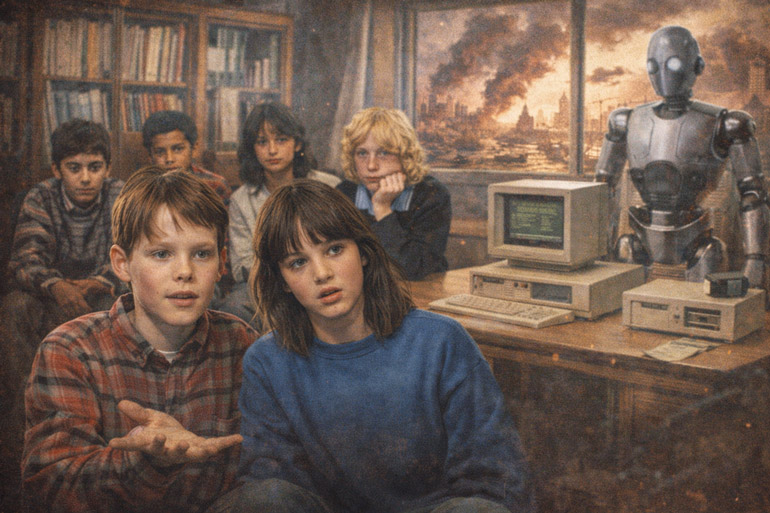
There’s something oddly humbling about listening to a bunch of 13 year olds from 1986 try to predict the future and hitting close to the mark. It was a simpler time. No Google, no social media, no doomscrolling before bed. Just kids riding their bikes until the streetlights came on, recording songs off the radio, and yelling “don’t pick up the phone” when someone was taping a cassette.
In a repeat of a 1966 “what if” experiment, these Gen X kids were asked what life might look like in 2020. And let’s just say, it wasn’t all flying cars and robot maids.
Instead of shiny, perfect futures, their ideas were big, bold, and a little chaotic. Which feels very on brand for a generation raised on latchkey afternoons, questionable TV ads, and being told to “just be home by the time the street lights come on”.
Fast forward to now and some of those guesses feel less like guesses and more like something uncomfortably predictive.
1. They thought computers would run everything
One kid said computers and automation would take over and there wouldn’t be enough jobs. Back then, a “computer” was a chunky beige box that took its sweet time loading anything and made a noise like it was thinking too hard about it.
Now everything is online, everything is automated, and half the time you’re one forgotten password away from giving up entirely. Self-serve checkouts quietly judging your every scan, apps asking for updates at the worst possible moment, and systems that only seem to work when you’re not in a rush.
Funny how that turned out.
2. They were convinced the world would be overcrowded
Another prediction was that the population would explode and people would end up living in giant buildings, underground, or even underwater. We’re not living under the sea, but the feeling of “too much” is hard to miss.
Back in the 80s, busy meant a Saturday trip to the local shopping centre or a queue at the video store while someone rewound a tape they’d forgotten to rewind at home.
Now it feels like everywhere, all the time.
Shops packed, roads clogged, calendars full before the week even starts. Everything feels like it’s running at capacity.
3. They were worried about war and destruction
This one hits a bit harder given what’s going on in the world today. These kids talked about nuclear war, dangerous technology, and the idea that the world could become unsafe.
At the time, it sounded like worst case scenario thinking, something far away and unlikely. Now it doesn’t feel so simple.
The news has a way of making the world feel heavy in a different way. The details change, but that underlying tension hasn’t really gone anywhere.
What’s striking is how young they were when saying it, and yet how tuned in they already were to the bigger picture.
4. They thought computers might run the country
Not in a sci-fi takeover way, just in how much everyday life now runs on systems you don’t really think about until they stop working.
And when they do, everything stops. Payments don’t go through, websites give up, apps freeze at the worst possible moment, and something simple turns into a long wait with nothing much you can fix yourself.
Back in the day, there was usually a way to sort things out on your own or work around it. Now most of the time you’re just stuck refreshing the screen and hoping it comes back.
5. They imagined telepathy
One kid thought we might be able to send thoughts straight to each other’s brains. Back then, communication was a landline phone in the kitchen and a quick yell to someone down the hall.
Now it’s messages, voice notes, video calls, constant notifications. Always connected, never really off. And somehow, misunderstandings still happen over a single message because context is so hard to discern online.
So maybe reading minds wouldn’t have solved much anyway.
6. They didn’t think we’d be living on Mars
Interestingly, they didn’t think we’d be living on other planets by now, and they were right. No Mars colonies, no space commuting, no hopping between worlds for a quick change of scenery. Just the same old Earth.
And in a way, it makes sense. Life here is still more than enough to deal with. Still busy, still chaotic, still full of the usual everyday noise. The future might have moved on in plenty of ways, but when it comes to packing up and heading off-planet, we’re all still very much right where we started.

Both 1966 and 1986 kids were really just reacting to the world around them.
In 1966, it was Cold War tension, nuclear fear, and big talk about overpopulation and pollution, so it makes sense their ideas leaned towards the world falling apart or becoming unliveable.
By 1986, the mood had shifted a bit. Computers were starting to show up in everyday life, automation was creeping in, and there was still that lingering global uncertainty, so the focus shifted more towards technology taking over and life becoming more system driven.
Different decades, different worries, but the same pattern underneath it all. Kids weren’t really guessing the future so much as reflecting on the noise of their own time.
Which is where it gets interesting. Because it makes you wonder what kids today would say if you asked them to picture life 30 or 40 years from now, growing up with AI, constant connectivity, and a world that already feels like it’s moving faster than anyone can keep up with.
What to read next
- How Preparing For Your Future Can Help You Live In The Present
- Fun 80s and 90s Kids’ Toys – Mini Pocket Pianos and Fashion Plates, Oh My!
- Growing Up in the 80s … A Trip Down Memory Lane




1 Comment
Computers still take time to load up. They “seize up” at the most inconvenient times.
They have definitely made some jobs obsolete.
A disaster when you work for a national company and all computers are connected to head office, especially if the main computer breaks down in one state it “blocks” every state system.